We are pleased to see this excellent review published by Baptist historian Michael Haykin of this recent title: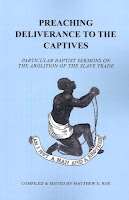
Matthew E. Roe, compiled and ed., Preaching Deliverance to the Captives: Particular Baptist Sermons on the Abolition of the Slave Trade (N.p., 2021), 213 pages.
One of the most amazing developments in the long eighteenth century has to be the moral and philosophical struggle waged by British abolitionists against the slave trade and slavery. And critical to its success was the key role played by British evangelicals. The name of the Anglican evangelical abolitionist William Wilberforce (1759–1833) is justly famous in this regard. But there were a multitude of others who also made significant contributions to the struggle. This newly-published volume of sermons on the abolition of the slave trade by five Particular Baptist pastors is revelatory of one of these significant contributions, that of the Particular Baptists.
Matthew E. Roe, who has self-published these sermons, places them in context in a detailed introduction (pp. 3–23). He shows the way that these sermons represent not simply the views of five individual pastors, but those of an entire denomination. Roe begins with the citation of texts from three Baptist associations—the Northamptonshire, the Western, and the Yorkshire and Lancashire—that reveal what one of them called “our deepest abhorrence” of the slave trade (p. 5). The concurrence of individual Baptists such as Martha Gurney (1733–1816), William Carey (1761–1834), Robert Hall, Jr. (1764–1831), John Rippon (1751–1836), and John Collett Ryland (1723–1792) in this detestation are also detailed (p.6–13). Roe notes key themes in the sermons, such as the inherent equality of all human beings, the duty of Christians to promote benevolence, and the utter injustice of the African slave trade (p.13–17). Despite the common Particular Baptist concern about bringing politics into the pulpit, these preachers were convinced that they had to speak to this issue, for it was a moral issue, not a political one per se (p. 19–21).
The five sermons—preached by Robert Robinson (1735–1790), James Dore (1763–1825), John Beatson (1743–1798), Abraham Booth (1734–1806), and John Liddon (d.1825)—were all preached within a five-year span, from 1788 to 1792, a period of intense activity by the abolitionists to secure the end of the slave trade. It was to be another fifteen years, though, before Parliament abolished the “diabolical traffic” (the words of John Liddon, p. 190). They are all reproduced in full with a minimum of editing. Each of them is introduced by a biographical sketch of the preacher. Following each sermon Roe has assembled various critical reviews that appeared when these sermons were first published. A few of these reviews are quite critical. For my part, however, each of these sermons is a gem and together they provide a fabulous window onto the way scriptural reasoning was the primary influence shaping the arguments of these abolitionists. The sermons by Dore and Booth are especially powerful in their exegesis and application. That by Robinson is probably the weakest of the five. It was preached during the closing years of his life when he was theologically confused—“ruined by pride” was the estimation of the evangelical Anglican John Berridge (1716–1793) (p. 31). Central to Roe’s publishing of these sermons is a desire “to inspire the modern reader when approaching similar issues today.” Slavery and trafficking in human persons still exist in the modern world, as well as “other forms of injustice” and “disturbing scenes of oppression.” And these call for the exercise of Christian benevolence (p. 22). These eighteenth-century preachers do indeed give us a great model to follow. Moreover, though Roe does not mention this, they also provide a substantial critique of some Christians in our day, who wish to mount a defence of slavery. Simply put, their arguments would astonish these Baptist preachers, who are generally far better guides to Scripture and Christian practice.
Michael A.G. Haykin The Southern Baptist Theological Seminary Louisville, KY
Published in The Journal of Andrew Fuller Studies, No 4, February 2022.


