Showing posts with label Slave Trade. Show all posts

Saturday, 5 March 2022

Particular Baptist Sermons on the Slave Trade - A Review

We are pleased to see this excellent review published by Baptist historian Michael Haykin of this recent title:
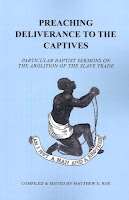
Matthew E. Roe, compiled and ed., Preaching Deliverance to the Captives: Particular Baptist Sermons on the Abolition of the Slave Trade (N.p., 2021), 213 pages. 
One of the most amazing developments in the long eighteenth century has to be the moral and philosophical struggle waged by British abolitionists against the slave trade and slavery. And critical to its success was the key role played by British evangelicals. The name of the Anglican evangelical abolitionist William Wilberforce (1759–1833) is justly famous in this regard. But there were a multitude of others who also made significant contributions to the struggle. This newly-published volume of sermons on the abolition of the slave trade by five Particular Baptist pastors is revelatory of one of these significant contributions, that of the Particular Baptists. 
Matthew E. Roe, who has self-published these sermons, places them in context in a detailed introduction (pp. 3–23). He shows the way that these sermons represent not simply the views of five individual pastors, but those of an entire denomination. Roe begins with the citation of texts from three Baptist associations—the Northamptonshire, the Western, and the Yorkshire and Lancashire—that reveal what one of them called “our deepest abhorrence” of the slave trade (p. 5). The concurrence of individual Baptists such as Martha Gurney (1733–1816), William Carey (1761–1834), Robert Hall, Jr. (1764–1831), John Rippon (1751–1836), and John Collett Ryland (1723–1792) in this detestation are also detailed (p.6–13). Roe notes key themes in the sermons, such as the inherent equality of all human beings, the duty of Christians to promote benevolence, and the utter injustice of the African slave trade (p.13–17). Despite the common Particular Baptist concern about bringing politics into the pulpit, these preachers were convinced that they had to speak to this issue, for it was a moral issue, not a political one per se (p. 19–21). 
The five sermons—preached by Robert Robinson (1735–1790), James Dore (1763–1825), John Beatson (1743–1798), Abraham Booth (1734–1806), and John Liddon (d.1825)—were all preached within a five-year span, from 1788 to 1792, a period of intense activity by the abolitionists to secure the end of the slave trade. It was to be another fifteen years, though, before Parliament abolished the “diabolical traffic” (the words of John Liddon, p. 190). They are all reproduced in full with a minimum of editing. Each of them is introduced by a biographical sketch of the preacher. Following each sermon Roe has assembled various critical reviews that appeared when these sermons were first published. A few of these reviews are quite critical. For my part, however, each of these sermons is a gem and together they provide a fabulous window onto the way scriptural reasoning was the primary influence shaping the arguments of these abolitionists. The sermons by Dore and Booth are especially powerful in their exegesis and application. That by Robinson is probably the weakest of the five. It was preached during the closing years of his life when he was theologically confused—“ruined by pride” was the estimation of the evangelical Anglican John Berridge (1716–1793) (p. 31). Central to Roe’s publishing of these sermons is a desire “to inspire the modern reader when approaching similar issues today.” Slavery and trafficking in human persons still exist in the modern world, as well as “other forms of injustice” and “disturbing scenes of oppression.” And these call for the exercise of Christian benevolence (p. 22). These eighteenth-century preachers do indeed give us a great model to follow. Moreover, though Roe does not mention this, they also provide a substantial critique of some Christians in our day, who wish to mount a defence of slavery. Simply put, their arguments would astonish these Baptist preachers, who are generally far better guides to Scripture and Christian practice. 
Michael A.G. Haykin The Southern Baptist Theological Seminary Louisville, KY

Published in The Journal of Andrew Fuller Studies, No 4, February 2022.

Saturday, 17 July 2021

Particular Baptists and Abolition

For many the lock-downs that we have undergone over the past 18 months have provided an opportunity to do things that they may not otherwise have had time for. For one member of our household this meant a college research project extending far beyond its original remit and becoming a labour of love which has culminated in the publication of a book (perfect when you just happen to have a bookshop to sell it in 😉)...

When we think of the campaign to abolish the slave trade, the tireless work of Wilberforce and his friends is uppermost in our minds. But Particular Baptists played an important role in the campaign, speaking out against the abhorrent trade in sermons, petitions and letters.

This book brings back into print some of these historic sermons, each with a biographical sketch of the preacher, and discusses the role of non-comformists in garnering the support of the wider religious public.

"The slave trade and slavery may have been abolished centuries ago, yet modern slavery still exists along with many other forms of injustice. These sermons challenge us to continue in the Christian duty of benevolence and to affirm Christian attitudes to equality when faced with increasingly disturbing scenes of oppression across the world" (quoted from the preface).

Preaching Deliverance to the Captives: Particular Baptist Sermons on the Abolition of the Slave Trade, compiled and edited by Matthew Roe, £8.99


Wednesday, 12 May 2021

Thomas Clarkson - The Giant with One Idea

12th May 1789 was the day that William Wilberforce made his first speech in parliament against the slave trade. He spoke for three and a half hours! Today therefore seems a fitting day to post a review of the latest Trailblazer book about Thomas Clarkson the abolitionist who worked closely with Wilberforce.

Latest Trailblazer on Thomas Clarkson

Thomas Clarkson: The Giant with One Idea 

The campaign to abolish the slave trade was motivated by Christian ideals, its arguments presented in Christian language, and, above all, with committed Christians as its leaders. Of these, William Wilberforce, the great abolitionist MP and the campaign’s leader in Parliament, is the most well known. Yet just as important, though sadly overlooked (especially in Christian writing on abolition), was Thomas Clarkson. As this book details for a younger audience, he drove the campaign and turned it into a pioneering popular movement, gathering evidence, witnesses, supporters and petitions. The reader gains a vivid sense of the difficulties this involved, the many dangers and disappointments along the way, Clarkson’s illness and partial retirement, and the crowning triumph when abolition was finally achieved in 1807. His work continued after this, pressuring the government to force other countries to abolish their slave trades. Clarkson also took part in the campaign against slavery itself, although less focus is afforded to it here, which was successful in 1833. Despite this, what is presented is the picture of a dedicated man, committed to helping the downtrodden and oppressed and motivated in this by his Christian faith. It is written in a slightly fictionalised style to engage children, but will be of benefit to parents and young ones alike for discovering the life and oft forgotten efforts of Thomas Clarkson. It is only to be lamented that there is no full length, modern biography of Clarkson for adult readers.

There are some, though no major, historical inaccuracies in this book, primary among them the attribution of the pamphlet encouraging the boycott of sugar mentioned on p. 97 to the Whig MP Charles James Fox (erroneously referred to as Lord Fox at points). This pamphlet, entitled An Address to the people of Great Britain, was in fact authored by William Fox, a printer who attended James Dore’s Particular Baptist chapel in Maze Pond, London (itself a hotbed of abolitionism, with Dore preaching against the trade in 1788). The date of abolition is also given as the 24th February 1807, the date of the second reading of the Bill in the House of Commons, rather than the 25th March, when the Bill was given Royal Assent. However, these minor errors should not detract from the enjoyment that will be found reading this book. The small section on modern slavery at the end reminds the reader of the continued existence of this most inhuman of institutions, and it is to be hoped that the life and efforts of this most important of figures will inspire us both to look back to the valuable lessons of the original anti-slavery campaign, and apply these to the similar issues faced today.

Matthew Roe

Thomas Clarkson: The Giant with One Idea, by Emily Maurits, published by Christian Focus Publications, £5.99

Thursday, 29 March 2007

Amazing Grace

It's the best film I've seen all year - but then again it's the only one. Wilberforce was rather more dashing than real life portraits suggest, and there was a hint of Bob Geldof about his dishevelled looks at times. Was this a deliberate ploy to link the two at a subliminal level? But they are poles apart in the motivations that drive them, although Wilber's evangelical Christianity is not given emphasis by this film. Sadly, John Newton is also poorly portrayed. This is best redressed by reading his 'Letters' (Banner of Truth paperback edition available, hardback due April) or better still, the original 'Cardiphonia' or 'Utterance of the Heart' as it is now rendered in the Gospel Mission edition.
The lesson is simple - see the film, and then read the books. You won't regret it.
Jeremy

Birthday Treat

It was my birthday yesterday. Don't ask how old. When I told Matt he kindly commented 'that's old' with GREAT emphasis! We had a customer in looking at Wilberforce books and it got us going on the Wilberforce theme -one thing led to another and we decided to go and see the film 'Amazing Grace' (a sort of 'birthday treat'!). For those of you that don't know, 'Amazing Grace' tells the story of William Wilberforce and his battle with the British establishment in bringing about the abolition of the slave trade. It has certainly given me further appetite for reading about both Wilberforce and also John Newton. Wilberforce was influenced by the ministry of John Newton and was supported by him in his fight against slavery. I will be taking a copy of 'Out of the Depths' (the autobiography of John Newton) home. I'll let you know how I get on with it...
Lorna
p.s. yes the film was worth seeing -birthday or no birthday!

Thursday, 22 March 2007

Wilberforce

As 25th March approaches, the 200th Anniversary of the passing of the Bill to abolish the Slave Trade will be observed in various ways. Christian publishers have certainly not forgotten it. Here is a listing, by no means comprehensive, of the books we have on Wilberforce:-


Day One have weighed in with another in the 'Travel with...' Series. Rather confusingly they have another of a similar name for children in their large format 'Footsteps of the Past' Series. For devotees there is a '365 Days with...', and most recently, a new study by John Pollock - 'Abolition!'


Kingsway have republished the classic Pollock biography 'Wilberforce'.


Christian Focus have had 'William Wilberforce - Vital Christianity' by Murray Pura out for some time. They have also added 'The Freedom Fighter' by Derick Bingham to their 'Trailblazers' Series for children, as well as an interesting book on the slave trade itself called 'Voices Against Slavery' also aimed at young people.

One other book - only just out in time from Crossway - is 'Amazing Grace in the Life of William Wilberforce' by John Piper. This follows a theme not lost on other writers, of the relationship between old John Newton and Wilberforce, especially in the way that Newton encouraged him to believe that just because he had been converted didn't mean that Wilberforce should think that his career in politics was over.
You really are spoilt for choice now!
Jeremy